Surf etiquette in Morocco is not a special set of rules invented for visitors. It is the shared way surfers reduce collisions, decide who has priority and keep a busy lineup fair. The basics travel with you: choose conditions that match your ability, look before taking off, do not drop in, control your board and communicate clearly.
What changes from beach to beach is the setting. A sandy beginner area, a rocky point and a fast reef break do not have the same entry, current, crowd or margin for error. That is why etiquette begins before you paddle out. This beginner guide explains the common rules and shows where local advice matters around Tamraght, Taghazout and the wider Moroccan coast.
Etiquette is safety, fairness and awareness
Surf etiquette is often described as “unwritten,” but the main ideas are widely taught. Surfing England’s wave-riding guidance identifies the surfer closest to the peak as the person with priority, warns against dropping in and snaking, and asks surfers to communicate, control their boards and be kind.
These are everyday lineup principles, not a promise that every situation is obvious. Waves can split in two directions, peaks can shift and two surfers may believe they are deepest. If you are unsure, pull back, speak clearly and let the safer option win. Missing one wave is better than forcing a collision.
Competition priority systems are more formal and may use judges, coloured displays and heat rules. Do not copy a contest rulebook into a recreational lineup as if a judge were present. In ordinary surfing, awareness and communication remain essential.
Choose the right place before learning the lineup
Good manners cannot make an unsuitable break safe. The Moroccan National Tourist Office’s official ocean guide advises surfers to know their level and ask for guidance so they do not take unnecessary risks at an unsuitable spot. It also describes Morocco as having beach, reef and point breaks for different abilities.
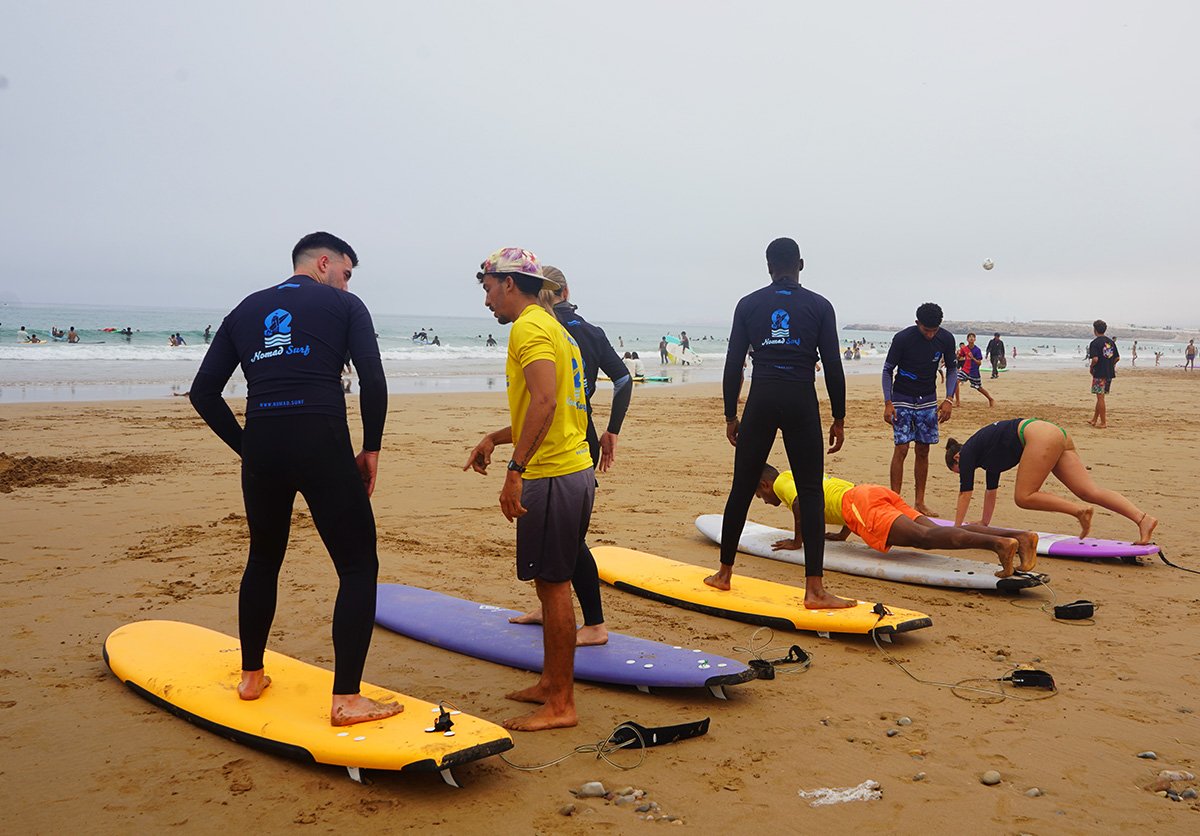
A beginner working in white water usually does not need to join the outside lineup at all. Build control in an area selected by your instructor: carry the board safely, stop it, fall away from it, look around before catching a wave and follow recall signals. Moving outside too early can place you among faster riders before you can steer or stop reliably.
Before paddling out independently, ask about:
- the safest entry and exit for the current tide;
- rocks, shallow sections, currents and places where you could be cut off;
- the usual take-off zone and the route used to paddle back out;
- whether the break suits your real level today, not your best-ever session;
- where lessons, swimmers or other water users are operating.
Nomad’s surf-level guide helps you describe observable skills instead of relying on a vague label. Being honest about paddling, take-offs, steering and ocean awareness helps a coach choose a more appropriate zone.
Understand priority before you take off
On a wave breaking in one direction, priority normally belongs to the surfer closest to the breaking part of the wave—the peak. Before committing, look toward the peak. If someone is already riding or is taking off from the inside position, stop paddling and let the wave pass.
A drop-in happens when you take off in front of a surfer who already has the wave. It can ruin the ride and create a collision. A snake happens when you repeatedly paddle around another surfer to take the inside position instead of waiting fairly. Both damage trust in the lineup.
Priority does not mean entitlement to every wave. If you have a board that catches waves earlier, share opportunities. If a peak is crowded, consider waiting, moving to a suitable quieter area or returning at another time. Never solve uncertainty by paddling more aggressively.
Paddle out without crossing someone’s ride
Watch several waves from shore before entering. Look for where people take off, where they finish rides and whether there is a channel. When paddling back out, avoid the path of a surfer already riding. If you are caught between the rider and the open face, paddle toward the white water when that is the safer escape rather than racing across the surfer’s line toward the shoulder.
Keep enough distance for mistakes. Hold on to your board whenever you reasonably can; a loose board can travel through the white water and hit someone behind you. Do not rely on the leash as permission to throw the board. If conditions are too powerful for you to control it, that is a sign to move to an easier area or end the session.
When finishing a wave, look before turning or kicking out. Other surfers may be paddling behind the section you cannot see. Control and awareness matter at the end of a ride as much as at take-off.
Communicate early and treat local knowledge with respect
A clear call of “left” or “right” can remove doubt when a wave offers two directions. Eye contact, a raised hand and a short apology can also prevent a mistake from turning into an argument. If you drop in accidentally, get off the wave safely, apologise and change your behaviour on the next set.
Respect for local surfers does not mean that one person owns the ocean. It means recognising that regular surfers and local instructors may understand a break’s currents, rocks, tide changes and crowd patterns better than a visitor. Ask politely, observe how the lineup works and do not paddle straight to the deepest position as soon as you arrive.
Morocco’s official tourism guide describes the coast as welcoming and recommends learning with recognised professionals. A lesson or guided session is useful not only for technique but also for learning how the specific break works that day. Nomad’s current surf packages combine coached sessions with time to practise; the daily location and plan remain condition-dependent.
A simple plan for your first lineup
- Watch from shore. Identify the peak, ride direction, paddle route, crowd and obvious hazards.
- Ask for local advice. Confirm the entry, exit, tide and whether the break suits you now.
- Enter away from active riders. Follow the route explained by your coach or guide.
- Sit wide at first. Observe several sets before moving closer to the take-off zone.
- Check toward the peak. Do this before every take-off, not only on the first wave.
- Communicate your direction. Call left or right when it helps prevent uncertainty.
- Share and reset. After a wave, rejoin without snaking around people who have been waiting.
- Leave before control fades. Fatigue makes paddling, decisions and board control worse.
Quick answers about surf rules in Morocco
Do local surfers always have priority?
Priority on a wave normally depends on position, not nationality. Respect local knowledge, wait your turn and avoid arriving with an entitled attitude. If someone explains a hazard or asks you to move from an unsafe area, listen and reassess.
What should I do if I drop in by mistake?
Exit the wave as soon as you can do so safely, apologise and avoid repeating it. Do not argue while people are moving through the impact zone. A simple, sincere acknowledgement is usually more useful than a long explanation.
Should a complete beginner paddle into the outside lineup?
Usually not until an instructor says the surfer has the control, awareness and skills for that setting. White-water practice is not a lesser experience; it is where beginners learn to stop, steer, fall safely and manage space before faster unbroken waves add more risk.
Good surf etiquette is less about memorising slang than making predictable, considerate decisions. Look before you go, protect other people from your board, share waves and let local conditions guide the session. If you are planning a first trip, tell Nomad your current level and what you want to learn. The team can explain the suitable package and coaching approach for your dates.