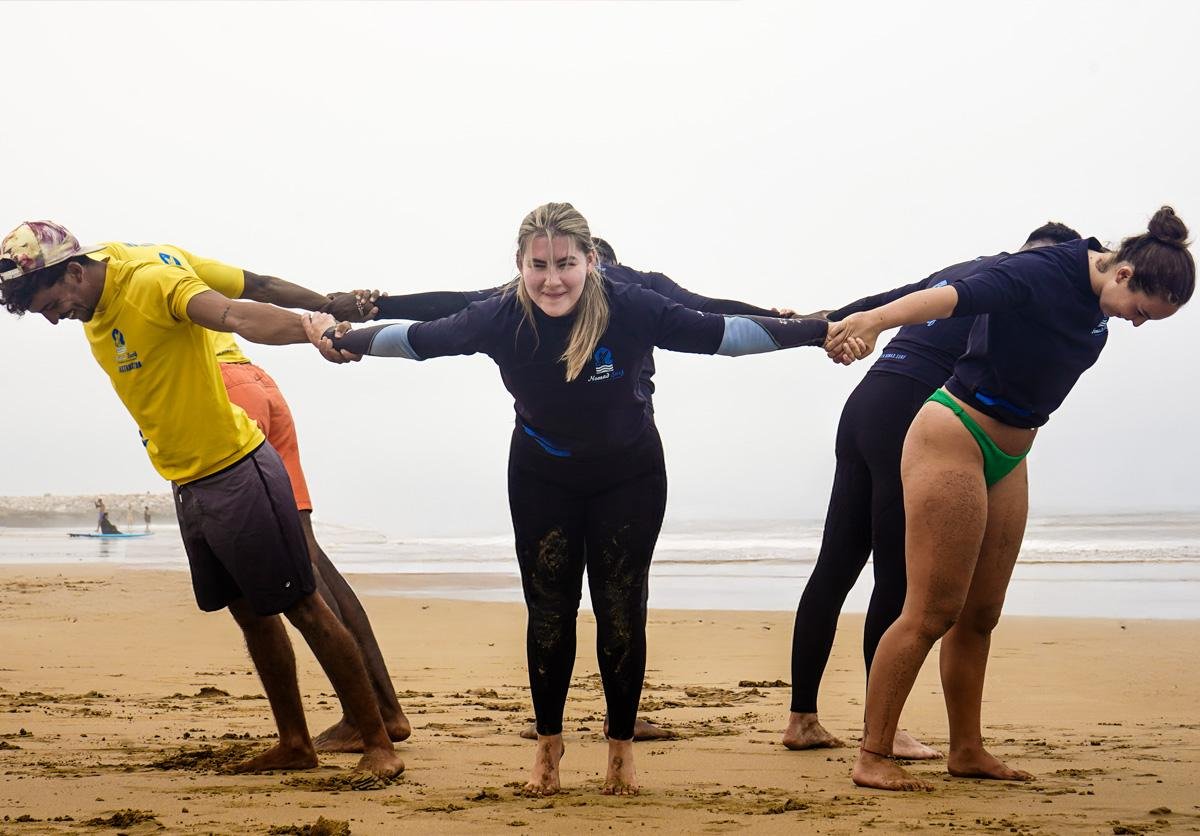
On day three in Tamraght, you catch an unbroken wave, stand up and ride toward the beach. Brilliant. You’ve progressed—but you haven’t magically become intermediate.
So, how long does it take? There’s no honest universal number. A focused week can improve your pop-up, paddling, positioning and confidence on green waves. If you already catch some unbroken waves, it may push you into early-intermediate territory. If you’re starting from zero, it probably won’t—and any camp guaranteeing otherwise is selling a countdown, not teaching surfing.
The useful measure isn’t weeks or years. It’s whether you can make your own decisions in the ocean.
What does “intermediate surfer” mean?
Surf schools and booking forms use the label differently. Some call you intermediate after your first green wave; others expect controlled turns in changing conditions.
The Academy of Surfing Instructors’ progression framework divides surfing into several beginner and intermediate stages. Its early-intermediate level goes well beyond standing up once, which is why a single timeline doesn’t work.
For this article, an early-intermediate surfer can usually:
- Paddle out and position themselves without being shepherded into place.
- Choose suitable unbroken waves and catch them without a push.
- Trim along the face both frontside and backside.
- Control the board around other surfers and follow basic priority rules.
- Exit a wave deliberately instead of jumping off and firing the board behind them.
- Recognise when the conditions are beyond their ability.
That last skill matters. Someone may look competent once standing but still need close instruction because they can’t read currents, select waves or manage their board safely. The International Surfing Association’s course standards similarly connect green-wave ability with controlled left and right traverses and safe exits. The ride is only one part of surfing.
Three realistic one-week outcomes
What a week in Tamraght can do depends heavily on where you begin. These are reasonable targets, not promises.
You’re a complete beginner
Your first sessions involve handling the board, understanding the impact zone, finding a stable position, popping up and riding whitewater under control. It sounds simple until the classroom starts moving and slaps you in the face.
During a productive week, you may progress from assisted rides to catching broken waves yourself. If the conditions, confidence and fitness line up, you might attempt small unbroken waves with an instructor helping with positioning and timing.
A sensible target is control and repeatability: catching whitewater independently, steering, keeping hold of the board and understanding where you should sit. That’s real progress, even if the word “intermediate” still doesn’t apply.
You’re confident in whitewater
You can stand, steer and catch broken waves without a push. Now you need to paddle through waves, choose a peak, commit to a steeper take-off and stop travelling straight toward the beach like a mildly panicked passenger.
A suitable week can produce first green waves, better take-off angles and early trimming. But distinguish between two achievements:
- Assisted green wave: an instructor selects it, positions you and tells you when to paddle.
- Independent green wave: you identify it, adjust your position, catch it and exit safely.
The first is an important step. The second shows that genuine independence is developing.
You occasionally catch green waves
You’re closest to early-intermediate, but consistency tends to expose the truth. Can you repeat the result when the peak shifts? Can you go both ways? Can you catch waves without sitting exactly where a coach left you?
A focused week may improve wave selection, angled take-offs, trimming, basic bottom turns and confidence on your weaker side. Video feedback becomes useful here because what you think your body is doing and what it’s actually doing are often distant relatives.
You might leave surfing more consistently at an early-intermediate level. You might instead discover that your paddling or positioning is still beginner-level. That discovery is useful, even if it bruises the ego.
Count useful waves, not calendar years
“I’ve surfed for three years” tells us almost nothing. That could mean regular sessions near home or three holidays separated by eleven months of forgetting how paddling works.
Progress depends more on:
- Frequency: closely spaced sessions reduce the time spent relearning timing and balance.
- Useful wave count: ten manageable attempts can teach more than two hours getting flattened outside.
- Suitable conditions: the waves must challenge the skill without overwhelming your decision-making.
- Feedback: one clear correction applied immediately beats a six-part lecture remembered next summer.
- Independence: wave selection, positioning and timing eventually have to become yours.
Research into skill acquisition in surfing emphasises the changing relationship between the surfer, waves, weather and moving water. That helps explain why elapsed time—and piles of dry-land drills—don’t convert neatly into ocean competence.
Pop-up practice can fix an obvious movement problem, and fitness work can improve your capacity to paddle. Neither teaches you to select a shifting wave under pressure. The ocean part still needs the ocean.
If you surf only on holidays, expect some rust during your first sessions back. Understanding and balance may return quickly, while paddle fitness, timing and confidence often need rebuilding. Don’t use day one to judge the whole trip.
Don’t downsize your board to prove a point
A smaller board usually demands better paddling, positioning and timing while giving you fewer successful attempts. If your wave count collapses, your fashionable new board has become an expensive flotation-themed punishment.
A higher-volume foam board or forgiving hardboard can help you enter waves earlier and repeatedly practise trimming, direction changes and controlled exits. ASI’s framework introduces early-intermediate skills before treating consistent fibreglass-board surfing as a later milestone. Choose enough board for the day’s waves and your actual ability—not the surfer you’d like strangers on the beach to think you are.
More water time isn’t automatically better either. Fatigue produces weak paddling, late entries and collapsing pop-ups. Manageable nerves can sharpen attention; panic destroys timing. A smaller, cleaner session may teach you more than a heroic battle in waves you can’t handle.
How Tamraght supports progression
Tamraght doesn’t have one permanently perfect beginner wave. Nowhere does. Its practical advantage is access to several nearby beach-break options, allowing the day’s choice to change with the swell, wind, tide, crowds and sandbanks.
Crocro and the Imourane beach area can provide whitewater practice or first green-wave attempts on suitable days. Devil’s Rock may offer another option when the conditions and banks cooperate. Banana can sometimes suit improving surfers on higher-volume boards, but “mellow” isn’t a permanent setting at any surf spot.
A coach’s useful job is to inspect the actual ocean and find the least intimidating place that still trains your next skill. That might mean angled take-offs at one beach today and a return to whitewater board control tomorrow because the swell has increased.
Nearby Taghazout becomes relevant when transport, regional conditions or a particular spot justify going north. Its famous point breaks aren’t the default classroom for someone based in Tamraght. Surfing a recognisable name won’t accelerate your progress if the wave is too fast, crowded or consequential.
If you want appropriate equipment, feedback and daily spot selection rather than guessing alone, you can compare Nomad’s Tamraght surf packages. Choose according to your current skills and how much coaching you want—not the level you hope to write on the booking form.
Instruction, coaching or guiding?
Basic instruction suits surfers who still need close help with safety, board handling, whitewater and their first assisted green waves.
Progression coaching makes sense once you catch some waves independently but need targeted work on positioning, selection, take-off direction, trimming or turns. Video analysis is most useful when you produce enough repeatable rides to analyse.
Guiding assumes greater independence. You should be able to judge your limits, paddle out, follow etiquette and surf unbroken waves without constant instructions. A guide helps select an appropriate break and explains local conditions; they shouldn’t need to operate you by remote control.
When booking, describe observable skills. “I catch whitewater alone but need help choosing green waves” is much more useful than “advanced beginner, nearly intermediate, depending on breakfast.”
So when are you no longer a beginner?
You’re approaching intermediate when you can enter the water, choose and catch suitable unbroken waves, trim both directions, control your board around others and exit safely without depending on someone else for every decision.
One week in Tamraght may move you significantly closer. It may even consolidate those abilities if you arrive with a solid base. But it won’t happen on a guaranteed date. Eventually, you’ll notice that you’re surfing the session rather than being managed through it—and that’s a far better milestone than counting days.